
How AI Is Reshaping the Iran Conflict and Future Wars
How AI Is Reshaping the Iran Conflict and Future Wars
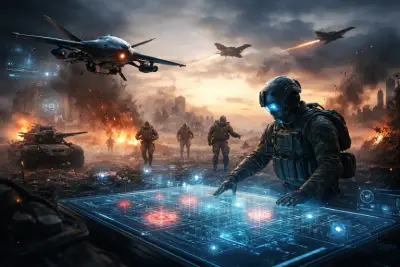
Artificial Intelligence in Warfare: How AI Is Reshaping the Iran Conflict and Future Wars
Artificial Intelligence Is Transforming Modern Warfare
As tensions escalate between the United States and Israel on one side and Iran on the other, artificial intelligence in warfare is becoming a critical factor that could redefine how modern conflicts are fought. Military strategies are no longer based solely on soldiers and conventional weapons. Instead, AI-powered systems are increasingly used to analyze intelligence, process massive amounts of data, and assist commanders in making battlefield decisions.
Recent reports suggest that advanced AI systems have already played a role in analyzing targets and supporting military operations in conflicts linked to Iran, highlighting how quickly this technology is entering real-world battlefields.
AI Systems on the Battlefield
Modern armies are investing heavily in military artificial intelligence to gain strategic advantages. One of the most notable systems is Maven Smart, an AI-powered platform that analyzes satellite imagery, drone footage, and surveillance data to identify potential targets and prioritize military actions.
These systems can process vast amounts of visual and intelligence data within seconds, allowing military planners to react faster than ever before. Supporters argue that such technologies could improve precision in military strikes and enhance operational efficiency.
However, experts warn that reliance on AI in military decision-making could also introduce new risks, particularly if algorithms misinterpret data or operate without sufficient human oversight.
Can AI Reduce Civilian Casualties?
Some analysts believe that AI-assisted targeting systems could help reduce civilian casualties by improving the accuracy of military operations. By analyzing patterns, locations, and movement data, AI may help distinguish between military targets and civilian areas.
Yet recent conflicts, including the wars in Ukraine and Gaza, show that civilian casualties remain high despite the increasing use of advanced technology. According to several researchers, there is still no clear evidence that artificial intelligence actually reduces mistakes in warfare.
In fact, critics argue that AI-driven targeting could accelerate decision-making so rapidly that it might increase the risk of errors or unintended escalation.
Autonomous Weapons: The Most Controversial Development
One of the most debated applications of AI in warfare is the development of autonomous weapons systems. These include drones and robotic systems capable of locating, identifying, and attacking targets with minimal or even no human intervention.
Supporters claim these systems could dramatically improve military efficiency and reduce risks for soldiers. However, the idea of machines making life-and-death decisions has sparked serious ethical and legal concerns worldwide.
International humanitarian law requires that human operators remain responsible for distinguishing between civilian and military targets, raising questions about whether fully autonomous weapons could ever comply with these rules.
Disputes Between Tech Companies and the U.S. Government
The growing role of AI in defense has also triggered tensions between technology companies and government institutions.
A notable example involves the AI company Anthropic, whose AI model “Claude” has supported the Pentagon’s Maven program under a contract worth around $200 million. The company reportedly refused to remove safeguards that prevent its AI from being used for mass surveillance or fully autonomous weapons systems.
Following the disagreement, the U.S. government temporarily halted the use of Anthropic’s technology and moved toward cooperation with OpenAI, another leading artificial intelligence company. The agreement reportedly includes strict limitations on how AI tools can be used in military operations.
Global Concerns Over an AI Arms Race
Many researchers warn that the world could soon face a new global arms race centered on artificial intelligence. As countries compete to develop more advanced AI-powered military systems, the risk of misuse or uncontrolled escalation may increase.
Scientists and technology workers from major companies such as Google and OpenAI have also expressed concern, calling for stronger safeguards to prevent AI from being used for mass surveillance or autonomous killing systems.
Experts believe that without clear international regulations, the rapid development of AI technology could fundamentally change the nature of warfare in the coming decades.
The Future of War in the Age of AI
Artificial intelligence is expected to play an increasingly important role in future conflicts, from intelligence analysis and logistics to drone operations and battlefield decision support.
However, the biggest challenge facing the global community is establishing clear legal and ethical frameworks that regulate the use of AI in warfare. Without such rules, the world may soon enter an era where algorithms influence decisions of war and peace.
The key question remains: Will humans remain in control of warfare, or could machines one day make those decisions themselves?In an increasingly digital ecosystem — stretching from Arabic websites and specialized blogs, alongside insights drawn from Egypt-based online stores, Kuwait stores, and vitamin e-commerce platforms. personal account security is no longer optional.