
AI Can Unmask Anonymous Accounts for Just $1
AI Can Unmask Anonymous Accounts for Just $1
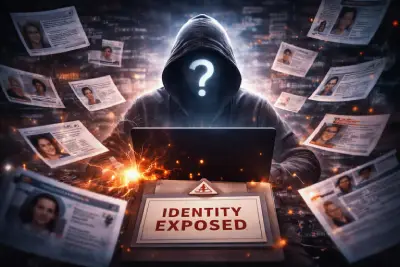
AI Can Unmask Anonymous Accounts for Just $1: New Study Warns of a Major Privacy Threat
In a development that is raising serious concerns among privacy experts, a new study suggests that modern artificial intelligence systems may now be capable of identifying the real people behind anonymous or pseudonymous online accounts.
The research, conducted jointly by Anthropic and researchers from ETH Zurich, reveals that large language models (LLMs) can analyze digital behavior and link anonymous online profiles to real-world identities with surprising accuracy.
The study was published as a preliminary research paper on the scientific platform arXiv under the title “Large-scale online deanonymization with LLMs.” It demonstrates how AI models can process massive amounts of public online data and detect patterns that reveal who is likely behind certain anonymous accounts.
How AI Breaks Online Anonymity
Traditionally, uncovering the identity behind anonymous accounts required long manual investigations. Analysts had to examine writing styles, posting habits, personal hints in conversations, and scattered digital clues across the internet.
However, AI can now perform this process automatically and at scale.
According to the researchers, AI models are able to:
-
Analyze writing style and linguistic patterns in posts and comments.
-
Extract implicit personal clues, such as interests, hobbies, and behavioral patterns.
-
Identify demographic signals, including profession, education level, or region.
-
Search across multiple platforms to find matching profiles or similar digital footprints.
By combining these signals, the system can narrow down the real person behind an anonymous account with remarkable precision.
Real-World Experiments
To test the effectiveness of the system, researchers conducted several experiments using real-world data sets.
One test involved linking Hacker News users to their LinkedIn profiles after removing obvious identifiers like names and usernames.
Another experiment analyzed anonymous accounts on Reddit, attempting to determine whether accounts across different communities belonged to the same individual.
Researchers also split the posting history of a single user into two separate accounts to see whether the AI could recognize that both belonged to the same person.
The results were striking. The AI achieved an identification accuracy of around 90%, with a recall rate of approximately 68%, significantly outperforming traditional methods used in online investigations.
The Cost of Revealing an Identity
Perhaps the most alarming finding in the study is the low cost of deanonymization.
Researchers estimate that identifying the real identity behind a single anonymous account could cost between $1 and $4.
This means large-scale identification campaigns could potentially be conducted at a very low cost, raising concerns about misuse by malicious actors, private investigators, or even governments.
A Serious Threat to Online Privacy
The implications of this technology are significant.
Many individuals rely on anonymous accounts online for legitimate reasons, including:
-
Journalists and investigative reporters
-
Whistleblowers exposing corruption
-
Political activists
-
Users discussing sensitive personal topics
These groups depend on what experts call “practical anonymity,” the idea that although clues exist online, connecting them to a real identity is difficult and time-consuming.
Artificial intelligence may dramatically weaken this barrier.
Calls for Stronger Privacy Protection
Although the study was conducted using public data and has not yet undergone full peer review, it has already sparked debate among cybersecurity experts and privacy advocates.
Researchers warn that internet users should reconsider how much personal information they share online, even on anonymous accounts. Small details spread across multiple posts may be enough for AI systems to piece together a real identity.
Experts are also calling for the development of stronger privacy tools, improved platform policies, and possibly AI systems designed to automatically mask sensitive personal signals before content is published.
The Future of Digital Anonymity
As artificial intelligence becomes increasingly powerful at analyzing massive datasets, the balance between technological discovery and personal privacy is becoming one of the biggest challenges of the digital age.
For now, the study delivers a clear message:
True anonymity on the internet may be far more fragile than many users believe. 🔐💻
In an increasingly digital ecosystem — stretching from Arabic websites and specialized blogs, alongside insights drawn from Egypt-based online stores, Kuwait stores, and vitamin e-commerce platforms. personal account security is no longer optional.
Other Topics You May Also Be Interested In
VPN Networks: Do They Really Protect You from Tracking and Malware?
LAiPIC Launches Doratoon AI Platform to Generate Full Anime Episodes from a Single Text Prompt
OpenAI Prepares First Hardware Product: AI-Powered Smart Earbuds
Faraday Future Launches Humanoid and Quadruped AI Robots with Paid Preorders at NADA 2026
Kaspersky Introduces AI-Driven SIEM Upgrade to Detect Account Takeovers Faster
Snap Showcases the Future of AR and AI Wearables at Web Summit Qatar 2026