Chinese Semiconductor Giants Call for Domestic ASML
Chinese Semiconductor Giants Call for Domestic ASML
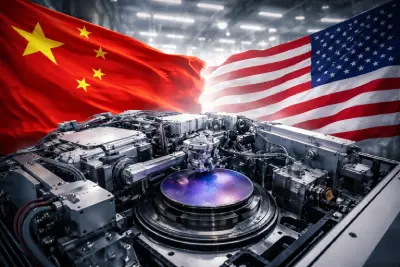
Chinese Semiconductor Giants Call for Domestic ASML Alternative Amid US Restrictions
Top executives in China’s semiconductor industry have called for a nationwide effort to develop a local alternative to ASML, the Dutch company specializing in advanced chip manufacturing equipment. The move aims to reduce China’s reliance on Western technology amid increasing U.S. restrictions.
The call appeared in a joint article co-authored by the founder of Semiconductor Manufacturing International Corporation (SMIC), alongside leaders from companies such as Empyrean Technology, Yangtze Memory Technologies, and Naura Technology Group, as well as academics from Tsinghua University and Peking University.
The authors noted that China’s semiconductor industry remains relatively small, fragmented, and underdeveloped, which disperses resources and limits the country’s ability to compete with global leaders in this critical sector.
Key Areas of U.S. Restrictions
The report highlighted three main areas where U.S. policies have constrained China’s semiconductor ambitions:
-
Electronic Design Automation (EDA) software, essential for chip design.
-
Silicon wafers, the fundamental material for producing processors.
-
Advanced manufacturing equipment, especially Extreme Ultraviolet (EUV) lithography machines, which are exclusively supplied by ASML.
EUV machines are among the most complex industrial devices in the world, with each containing over 100,000 components sourced from approximately 5,000 suppliers, while ASML integrates them into a single operational system.
China’s Race to Develop Domestic Technology
EUV technology is used to print ultra-fine patterns on silicon wafers, a critical step for producing high-performance processors.
However, the Dutch government has blocked the export of EUV machines to China under U.S. pressure.
Despite this, Chinese researchers have made progress on some components of EUV systems, including high-power lasers, precision optical systems, and mechanical platforms. The biggest challenge remains integrating these components into a fully functional industrial system.
Experts believe that achieving this goal will require nationwide coordination as part of China’s 15th Five-Year Plan, which extends until 2030.
Need for Consolidation and Resource Coordination
The report emphasized that building a “Chinese ASML” will require unified financial and human resources, as well as enhanced collaboration between companies in EDA, silicon materials, and chip design.
Currently, the industry is highly fragmented:
-
Over 100 EDA software development companies
-
Around 3,600 chip design firms
-
More than 180 semiconductor equipment manufacturers
This fragmentation underscores the necessity of coordinated efforts to achieve meaningful progress.
China’s EUV Development Project
Reports indicate that China is actively developing a domestic EUV machine in Shenzhen by dismantling and studying older ASML devices to understand their design.
A prototype was completed last year but has not yet produced functional wafers.
Some Chinese companies have reported progress in key components:
-
Glory Photonix claims to be the only domestic supplier of high-power lasers.
-
Beijing U-Precision Tech has developed a dual-platform system as an alternative to ASML’s Twinscan technology.
Global Tech Race
These efforts highlight the intensifying technological competition between China and the United States in semiconductors, which has become one of the most strategic and high-stakes arenas in global technology today.
Other Topics You May Also Be Interested In
VPN Networks: Do They Really Protect You from Tracking and Malware?
LAiPIC Launches Doratoon AI Platform to Generate Full Anime Episodes from a Single Text Prompt
OpenAI Prepares First Hardware Product: AI-Powered Smart Earbuds
Faraday Future Launches Humanoid and Quadruped AI Robots with Paid Preorders at NADA 2026