ChatGPT’s Lead Narrows as Gemini and Rivals Rapidly Close the Gap
ChatGPT’s Lead Narrows as Gemini and Rivals Rapidly Close the Gap

ChatGPT’s Lead Narrows as Gemini and Rivals Rapidly Close the Gap
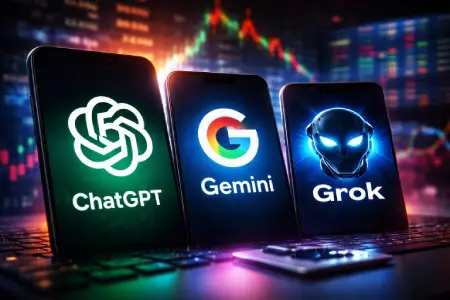
ChatGPT’s early dominance in the consumer AI market appears to be weakening as competitors—most notably Google’s Gemini—gain significant ground across both mobile applications and web platforms. The shift signals a more competitive phase in the artificial intelligence race, one that could influence OpenAI’s broader strategic ambitions, including potential public market plans.
Market Share Decline Signals Intensifying Competition
According to data from mobile analytics firm Apptopia, ChatGPT’s app market share declined from 69.1% in January 2025 to 45.3% in January 2026. During the same period, Google’s Gemini increased its share from 14.7% to 25.2%, marking one of the fastest growth rates among major AI chatbot platforms.
Meanwhile, Grok—the AI assistant developed under Elon Musk’s xAI initiative—also posted notable gains, climbing from just 1.6% market share to 15.2% within a year. The rapid rise of these competitors reflects a broader diversification of user preferences in the AI ecosystem.
Web Traffic Trends Reflect the Shift
The competitive shift extends beyond mobile applications. Data from Similarweb shows that Gemini’s web traffic surged by 28.38% in late 2025, while ChatGPT’s web traffic declined by 5.59% during the same timeframe.
In January 2026, Gemini’s website reportedly surpassed two billion monthly visits for the first time. Although ChatGPT experienced a modest recovery after consecutive months of decline, it remains below its October 2025 peak.
Google CEO Sundar Pichai recently revealed that Gemini now exceeds 750 million monthly active users, up from 650 million in the previous quarter. While ChatGPT is still estimated to lead with approximately 810 million monthly active users by late 2025, the margin between the two platforms is narrowing at an accelerated pace.
The Enterprise Market: A Different Battlefield
While consumer app usage and web traffic offer insight into public adoption trends, they represent only part of the broader AI market. Enterprise integration—often conducted through APIs rather than public-facing applications—plays a crucial role in determining long-term dominance.
In the enterprise segment, Anthropic has emerged as a strong contender. According to survey data from Menlo Ventures, Anthropic reportedly commands roughly one-third of the enterprise AI market, compared to 25% for OpenAI and around 20% for Google.
These figures suggest that while ChatGPT remains a leader in consumer engagement, enterprise competition is far more fragmented and dynamic.
A Maturing AI Ecosystem
The rapid growth of Gemini and Grok underscores a key reality: the AI chatbot market is evolving from a single-player dominance model to a highly competitive, multi-platform ecosystem.
Innovation cycles are shortening. Integration across productivity tools, search engines, cloud infrastructure, and enterprise systems is becoming a decisive advantage. Google’s ecosystem integration, Musk’s brand-driven momentum, and Anthropic’s enterprise focus are reshaping the competitive landscape.
For OpenAI, the challenge is no longer simply expanding usage—it is defending market share while scaling infrastructure, monetization, and enterprise relationships in an increasingly crowded field.
The Road Ahead
Despite losing significant market share, ChatGPT remains one of the most widely used AI platforms globally. However, the era of uncontested leadership appears to be over.
As the AI industry matures, sustained dominance will depend on innovation speed, reliability, ecosystem integration, enterprise partnerships, and user trust.
The race is no longer about who launched first.
It is about who adapts fastest.
Other Topics You May Also Be Interested In
VPN Networks: Do They Really Protect You from Tracking and Malware?
OpenAI Prepares First Hardware Product: AI-Powered Smart Earbuds
Kaspersky Introduces AI-Driven SIEM Upgrade to Detect Account Takeovers Faster
Snap Showcases the Future of AR and AI Wearables at Web Summit Qatar 2026
Google’s Genie Experiment Brings Real-Time AI Worlds to Life
Water Treatment: A Complete Professional Guide