
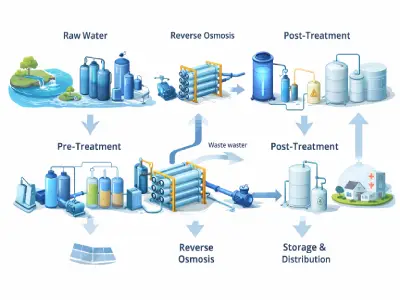
Water Treatment: A Complete Professional Guide
Water Treatment: A Complete Professional Guide

Water Treatment: A Complete Professional Guide From Raw Water to Safe Use – With a Detailed Step-by-Step RO Process
Introduction
Water treatment is one of the most critical engineering and environmental processes in the modern world. With increasing water scarcity, industrial expansion, and population growth, treating water efficiently is no longer optional—it is essential for public health, environmental protection, and sustainable development.
Water treatment refers to a set of physical, chemical, and biological processes designed to remove contaminants and improve water quality so it can be safely used for drinking, industrial operations, agriculture, or reuse.
Types of Water Treatment
Water treatment systems are designed based on the intended use of water. The most common categories include:
-
Drinking Water Treatment
-
Wastewater Treatment
-
Industrial Water Treatment
-
Desalination and Advanced Purification
Each type follows different standards, but many core processes overlap.
General Stages of Water Treatment
Regardless of application, most water treatment systems follow these fundamental stages:
-
Pre-Treatment
-
Primary Treatment
-
Secondary Treatment
-
Advanced / Tertiary Treatment
-
Final Disinfection
Among advanced treatment technologies, Reverse Osmosis (RO) plays a central role.
Stage 1: Pre-Treatment (Preparation Stage)
Purpose:
Protect downstream equipment (especially RO membranes) and improve overall system efficiency.
Step-by-Step Process:
-
Raw Water Intake
-
Water is collected from wells, rivers, lakes, or seawater sources.
-
-
Screening
-
Removes large debris such as sand, leaves, and suspended solids.
-
-
Coagulation
-
Chemicals like aluminum sulfate (alum) or ferric chloride are added.
-
These chemicals bind fine particles together into larger clusters.
-
-
Flocculation
-
Gentle mixing allows particles to form larger flocs.
-
-
Sedimentation
-
Heavy flocs settle at the bottom of tanks and are removed.
-
-
Media Filtration
-
Multi-media filters (sand, gravel, anthracite) remove remaining suspended solids.
-
-
Activated Carbon Filtration
-
Removes chlorine, organic compounds, odors, and colors.
-
Essential to protect RO membranes from chlorine damage.
-
Stage 2: Reverse Osmosis (RO) – The Core Technology
What Is Reverse Osmosis?
Reverse Osmosis is a membrane-based filtration process that removes dissolved salts, heavy metals, bacteria, viruses, and chemical contaminants by applying pressure to force water through a semi-permeable membrane.
RO System Components
-
High-pressure pump
-
RO membranes
-
Membrane housing vessels
-
Pressure gauges
-
Flow meters
-
Conductivity (TDS) sensors
-
Chemical dosing system
-
Control panel
RO Process – Step by Step
Step 1: Feed Water Pressurization
-
Pre-treated water enters the high-pressure pump.
-
Pressure applied depends on water salinity:
-
Brackish water: 10–20 bar
-
Seawater: 55–80 bar
-
Step 2: Membrane Separation
-
Water is forced through the RO membrane.
-
Membrane allows only water molecules to pass.
-
Dissolved salts, bacteria, and contaminants are rejected.
Step 3: Permeate and Concentrate Streams
-
Permeate: Purified water collected for use.
-
Concentrate (Reject): High-salinity water discharged or reused.
Step 4: Monitoring and Control
-
Conductivity sensors measure water quality.
-
Flow meters ensure correct recovery rates.
-
Pressure indicators detect membrane fouling.
Step 5: Chemical Dosing (During Operation)
-
Antiscalants prevent scale formation.
-
pH adjusters improve membrane performance.
-
Sodium metabisulfite neutralizes residual chlorine (if needed).
Stage 3: Post-Treatment
Purpose:
Improve taste, stability, and safety of treated water.
Processes Include:
-
pH Adjustment
-
RO water is slightly acidic.
-
Minerals like calcium carbonate may be added.
-
-
Remineralization
-
Improves taste and alkalinity.
-
-
Final Disinfection
-
UV sterilization or chlorination ensures microbiological safety.
-
Stage 4: Storage and Distribution
-
Treated water is stored in hygienic tanks.
-
Distribution systems ensure safe delivery to end users.
RO System Advantages
-
Removes up to 99% of dissolved salts.
-
Highly effective against bacteria and viruses.
-
Suitable for drinking, industrial, and medical use.
-
Scalable from small units to mega plants.
Common RO Applications
-
Drinking water plants
-
Bottled water factories
-
Hospitals and laboratories
-
Power plants
-
Food and beverage industries
-
Agriculture and greenhouses
Maintenance and Operational Considerations
-
Regular membrane cleaning (CIP)
-
Monitoring pressure drop
-
Replacing filters and cartridges
-
Periodic water analysis
The Future of Water Treatment
-
AI-based monitoring systems
-
Energy-efficient membranes
-
Zero-liquid-discharge (ZLD) plants
-
Smart water management platforms
Conclusion
Reverse Osmosis has become the backbone of modern water treatment due to its reliability, efficiency, and adaptability. When combined with proper pre-treatment and post-treatment stages, RO systems provide safe, high-quality water for nearly every application.
Investing in advanced water treatment technologies is not just a technical choice—it is a strategic decision for sustainability, health, and economic growth.
This content is part of continuous monitoring of Arabic websites and specialized blogs, alongside insights drawn from Egypt-based online stores, Kuwait stores, and vitamin e-commerce platforms. It also relies on a well-known social media services platform as a primary source for information, trends, and ongoing updates
Other Topics You May Also Be Interested In
NVIDIA Unveils Earth-2: A New Era of AI-Powered Weather Forecasting
Apple Unveils the New AirTag with Longer Range, Louder Sound, and Smarter Tracking
UK Leads Major Economies Most Affected by AI as Job Opportunities Decline
How to Stay Productive While Working From Home: A Practical Guide for Remote Workers
Study Reveals Growing Shift Toward Outsourced and Hybrid Security Operations Centers in the UAE
Public Wi-Fi Security Risks: 7 Hidden Threats and How to Protect Yourself
Social Engineering: How Dangerous Is It and How Can You Protect Yourself?
How Artificial Intelligence Will Reshape Banking in 2026: 13 Key Trends to Watch
Apple Announces Siri Update Powered by Google’s Gemini AI
Artificial Intelligence and the Future of Work: Between Innovation, Jobs, and Social Acceptance
The Internet of Things (IoT) and the Future of Cybersecurity
UAE Experts Program Opens Applications for Artificial Intelligence Track in January 2026
Kaspersky Warns of Sophisticated Phishing Campaign Exploiting OpenAI Team Invitations
Saudi Arabia Accelerates AI Infrastructure as Humain Secures $1.2 Billion Financing Deal
Understanding DDoS Attacks: How They Work and How to Mitigate Them
The Fifth Wave of Cybercrime: How AI Has Turned Digital Crime into a Global Industry